
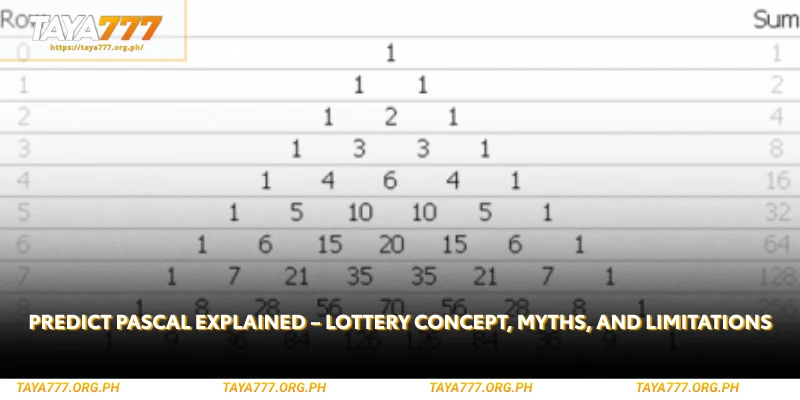
“Predict Pascal” is a term that often appears in lottery discussions and online forums, usually associated with claims about number prediction or improved winning chances. However, many players misunderstand what this concept actually represents. This article aims to clarify what Predict Pascal means, explain its mathematical background, and highlight why it should not be viewed as a reliable lottery prediction method.
What Is “Predict Pascal”?
Predict Pascal is not an official or scientifically recognized lottery prediction system. Instead, it is a popular term used within some lottery communities to describe an idea inspired by Pascal’s Triangle, a well-known mathematical structure.
Over time, the term has been simplified and shared informally, leading many players to believe it can be applied directly to lottery number selection. In reality, Predict Pascal is better understood as a conceptual reference rather than a proven method for forecasting lottery results.
Understanding Pascal’s Triangle in Mathematics
Pascal’s Triangle is a mathematical model introduced in probability theory and combinatorics. It is formed by arranging numbers in a triangular pattern, where each number is the sum of the two numbers directly above it.
In mathematics, this triangle is used to:
- Calculate combinations and binomial coefficients
- Analyze probability distributions
- Support algebraic expansions
Importantly, Pascal’s Triangle works within deterministic systems, meaning outcomes are defined by fixed mathematical rules. This structure is useful for understanding probability concepts, but it does not generate or control random outcomes.
Why Pascal’s Triangle Cannot Predict Lottery Results
Lottery draws are based on random and independent events. Each draw is unaffected by previous results, and every number combination has the same probability of appearing, regardless of past outcomes.
Pascal’s Triangle, on the other hand, is a predefined mathematical framework. While it helps explain how probabilities behave in theory, it does not interact with or influence real-world lottery systems. Applying it to lottery prediction creates a mismatch between deterministic mathematics and randomness-based games.
For this reason, using Predict Pascal as a tool to forecast lottery numbers is not scientifically valid.
Why the Predict Pascal Method Is Often Misunderstood
One reason Predict Pascal is frequently misunderstood lies in human psychology. People naturally look for patterns when reviewing past data, especially in games involving numbers. When patterns appear to repeat, it can create the impression that a formula or structure is influencing outcomes.
However, identifying patterns in historical results does not mean future outcomes can be predicted. In lottery systems, perceived patterns are usually coincidental rather than meaningful. Predict Pascal discussions often blur this distinction, leading to confusion between mathematical explanation and outcome prediction.
Responsible Perspective on Lottery Predictions
No mathematical model or conceptual system can guarantee lottery results. Any claim suggesting certainty or increased accuracy should be approached with caution. Lottery games are designed primarily for entertainment, and outcomes remain unpredictable by nature.
A responsible approach involves understanding the limits of prediction concepts, setting personal boundaries, and avoiding reliance on unverified systems. Viewing Predict Pascal as an educational topic rather than a strategy helps players maintain realistic expectations.
Conclusion
Predict Pascal is best understood as a commonly referenced concept rooted in mathematical theory, not as a dependable lottery prediction method. While Pascal’s Triangle plays an important role in probability education, it cannot determine lottery outcomes. By recognizing this distinction, players can make more informed decisions and approach lottery participation with clarity and responsibility.
